THE BLOG
Hello! I'm Amy and I've been running my microgreens farm, Nell's Urban Greens, from my garden grow house in Leeds, UK since 2017.
Over the years I've learnt a lot about growing, selling, making enough money to pay myself a regular salary, and building a business that works around real life.
This blog is where I share the practical advice, lessons and valuable insights I've picked up along the way.

Want to get started
straight away?
Access my Free Training here
If you haven’t got long to read this post, then the short answer is: Yes! They are, as long as you run your business properly.
To kick off my brand new blog(!) I’m starting with the numbers. You might enjoy the numbers, you might not be that keen at all, but if you’d like to be able to earn your living from growing and selling microgreens, then they’re important to know.
Hello! I’m Amy and I’ve been running my microgreens farm business, Nell’s Urban Greens, in Leeds, UK since 2017. For my first three years in business, I grew my microgreens in our conservatory and planted, harvested and packed in my kitchen. Once I knew I loved it and had a small solid customer base, I decided to scale up and I moved into the garden. I now have a great little set up in my insulated Grow House on the footprint of our old garage, where I’ve been running my business from ever since.
Since 2019, I’ve also been teaching and supporting others to set up and run their own microgreens businesses in their local communities throughout the UK.
If you love the idea of setting up your own microgreens business (or are even just curious), before you do *anything* else, you need to know this:
At current supplies costs and prices you can charge for your microgreens in the UK, will you be able to make a good enough profit so you can pay yourself an income?
That’s what I’m answering today for you in this post. I’ll cover:
✔ The profit can you make from selling microgreens (using real life, current examples),
✔ How you can maximise this margin,
✔ And the 2 key parts of your business that your profit margins are dependent upon.

I’m just heading into my 10th year of running Nell’s, and I work closely with other small scale microgreens farms too through my business course, so I know the current numbers pretty well.
A quick note about profit:
If you run your microgreens business as a sole trader, as opposed to setting it up as a Limited Company, then when I refer to profit I mean all the money that is left over after you’ve taken all of your expenses out of your sales total, not including paying yourself. If you set up your business as a Limited Company, then profit is the cash that’s left over in your business after all outgoings, including: operating costs, salaries and corporation tax. I’ve always run Nell’s as a sole trader, and I know many other small scale micros producers in the UK do as well, so when I refer to profit throughout the rest of this article, I’ll be referring to all the cash that’s left over after just the expenses have been taken off your sales totals. And this is the money you can pay yourself with.
The profit you can generate from growing and selling microgreens in the UK:
My business was in profit after 3 months of me trading and has continued to be so ever since. Not enough to pay me at that point, but my sales had taken over what I’d spent on my initial start up equipment and supplies.
Annually, you should aim to hit at least 70% profit on everything you sell, so that means spending no more than 30% on your operating expenses. Mine’s currently sitting at 27% expenses, 73% profit at 5 months into this financial year. And this covers ALL business expenses, not just the ones to produce each tray.
These percentages will differ from month to month, depending on what you need to buy, but these percentage targets should be what you’re aiming for over a full 12 months of trading. My business has only exceeded 30% expenses once in the past 9 years (it was 34%, as I invested new equipment when I scaled up). So this is at least one solid, real life example of how microgreens are profitable in the UK. AND I take every Friday, Saturday (minus 20 mins of watering and grow checks in the morning) and Sunday off. So it’s definitely a profitable and well balanced business to be in. If you design it this way!
Here are some actual numbers for one tray of microgreens:
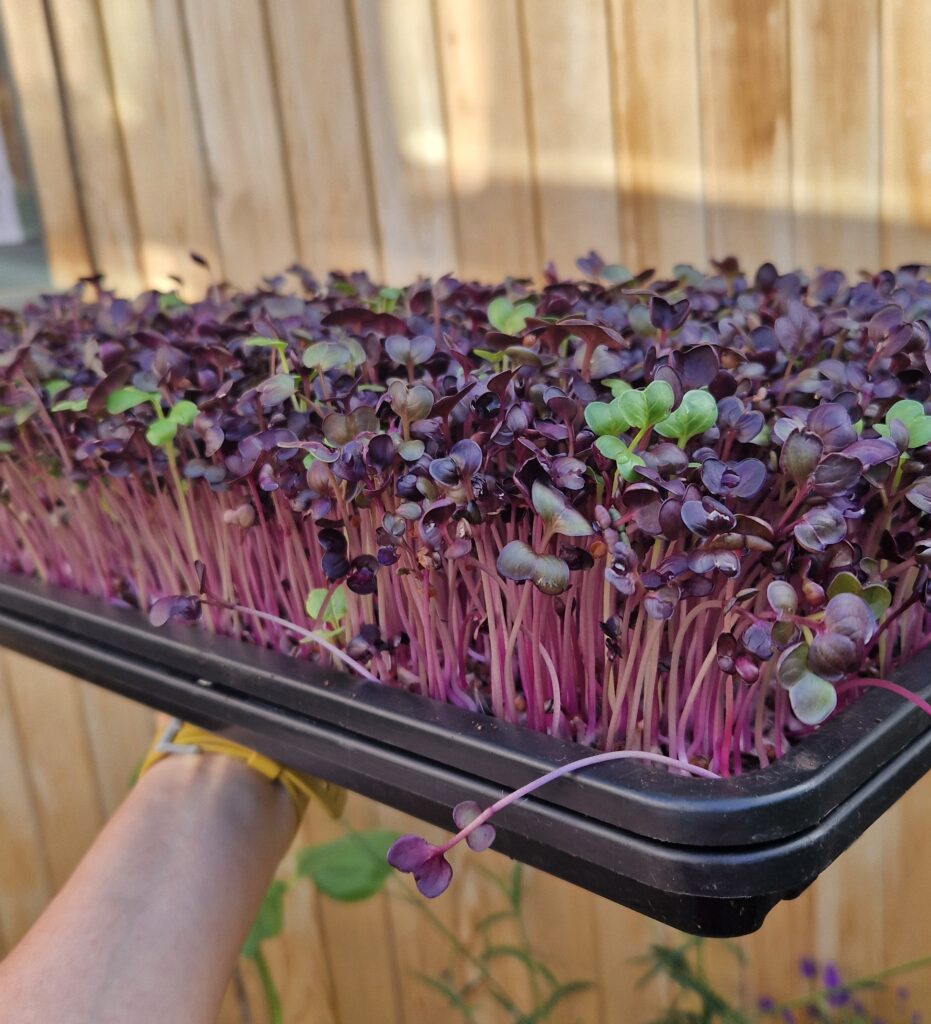
✔ 1 tray of organic Rambo (purple) Radish Microgreens from Grow Sow Greener costs £25/kilo, when you have a business account set up with them and buy in bulk (5kg+).
✔ For each microgreens tray, 45g of dry radish seed will produce 300g+ of radish microgreens in 7 – 9 days. That amount of seed costs £1.13 and compost per tray is now around the 35p mark, coir’s cheaper.
✔ That’s a total tray cost of £1.48
✔ You can sell 40g punnets of radish microgreens for £2.50 to chefs and £3 to the public.
So your tray profit here will be £17.27 (selling at £2.50) and £21.02 (selling at £3).
Full business profit (at 70%) on this tray of microgreens is £13.13 (selling at £2.50) and £15.75 (selling at £3).
That’s how you work out your profits.
And these are real life numbers, from a real-life operating microgreens farm in the UK, as of September 2026!
If you’re hitting at least 70% profit margins in your microgreens business, then your business will remain financially sustainable.
So how do you do everything you can to make sure you’re able to hit this 70/30% target each year?
You need to maximise your profit margins by:
✔ Streamlining your processes;
✔ Only spending the money you absolutely need to;
✔ Optimising your individual grow tray production;
✔ Finding the sweet spot between pricing and sales numbers.
✔ Selling plenty of microgreens!
I’ll pull the main two of these out for this article:
The 2 key parts of your microgreens business that determine your profit:
1. Overheads
I can’t stress enough how useful keeping your overheads as low as possible is for maximising your profits. You can start a microgreens business on a shoestring, so make the most of that! Some small bags of microgreens seeds from Grow Sow Greener, a few seed trays, some compost and a brightish windowsill is all you need to get growing and see if you enjoy it. If you do, and you have space at home to grow in and local people who have already enjoyed your samples and others who are keen to try, then you might want to scale up and turn this into a proper business.
Your capital overheads (in other words stuff you only probably need to buy once) will include: Grow Racks, LED lights, microgreens grow trays, a work table, fridge, dehumidifier, sharp knife, digital weighing scale & fans.
Your consumable overheads (the stuff that you use to produce your products that needs to be bought regularly) will include: Seed, compost/coco coir, packaging, labels, cleaning stuff, energy (usually electricity), vehicle fuel & maintenance, rent (if renting out premises).
You can minimise your overheads by:
1. Not buying stuff you don’t need to run the business profitably.
2. Buying your consumable inventory in bulk to access (sometimes significant!) discounts.
3. Keeping your business at home, or in the garden.
4. Making sure your grow room is well insulated, so that all your energy costs goes into actually producing microgreens and not to heat the outside.
2. Number of sales you make
If you earn 70% on every punnet of microgreens you sell, then the more you sell, the more profit you’ll make. Pretty straight forward. If you feel that your expenses percentage is creeping up past 30%, and you’re minimising your overheads as much as possible, streamlining your work tasks and optimising your tray production, then it’s time to try and add more customers onto your weekly supply. You’re heating the room anyway and you’re set up to harvest, pack and deliver, so adding more sales into this process will boost your profit margins. And ideally, these will be regularly increasing sales.

So many numbers get thrown around when it comes to the profit margins of microgreens. I wanted to share a clear and real-life version of these as it stands today in the UK’s small scale microgreens industry, so you can then make a much better-informed decision as to whether this business is for you.
A microgreens business is not a get rich quick scheme but what it is for me, and can be for you, is an extremely enjoyable, long-term enterprise from which you can make either a full or part time salary from. You can run it flexibly from home and reap the rewards of the satisfaction you get from growing delicious, healthy food for your local community.
Amy Wright
September 29, 2026
Is a Microgreens Farm Business Profitable in the UK?